
Xiaoyan (Candice) Qian
High-Risk AI Governance×AI System-Building
Email Google Scholar LinkedIn ORCID
AI PhD, The University of Hong Kong · R&D Manager and Functional Lab Lead, HKU-Avnet Joint AI Laboratory
In any high-stakes AI system, the deciding questions come after the model works: who is accountable, what the people affected are owed, who can override it. I work these questions where they bite hardest, in medical AI, where an ungoverned output reaches a patient. I build these systems and the governance they need before they do: one person doing what usually takes two. What I build is the connective tissue a clinical, ethics, and legal team needs to govern together, the shared scaffolding most projects under-resource. In practice that means executable governance frameworks, audit evidence, accountability structures, and regulatory-risk language a hospital, regulator, or legal team can act on, and I translate governance goals back into requirements a team can build against.
Current focus: Medical Digital Twin Initiative, AI Prototyping and Governance Framing
Taking one patient-facing system from research prototype toward responsible deployment, and building the governance that must be in place first.
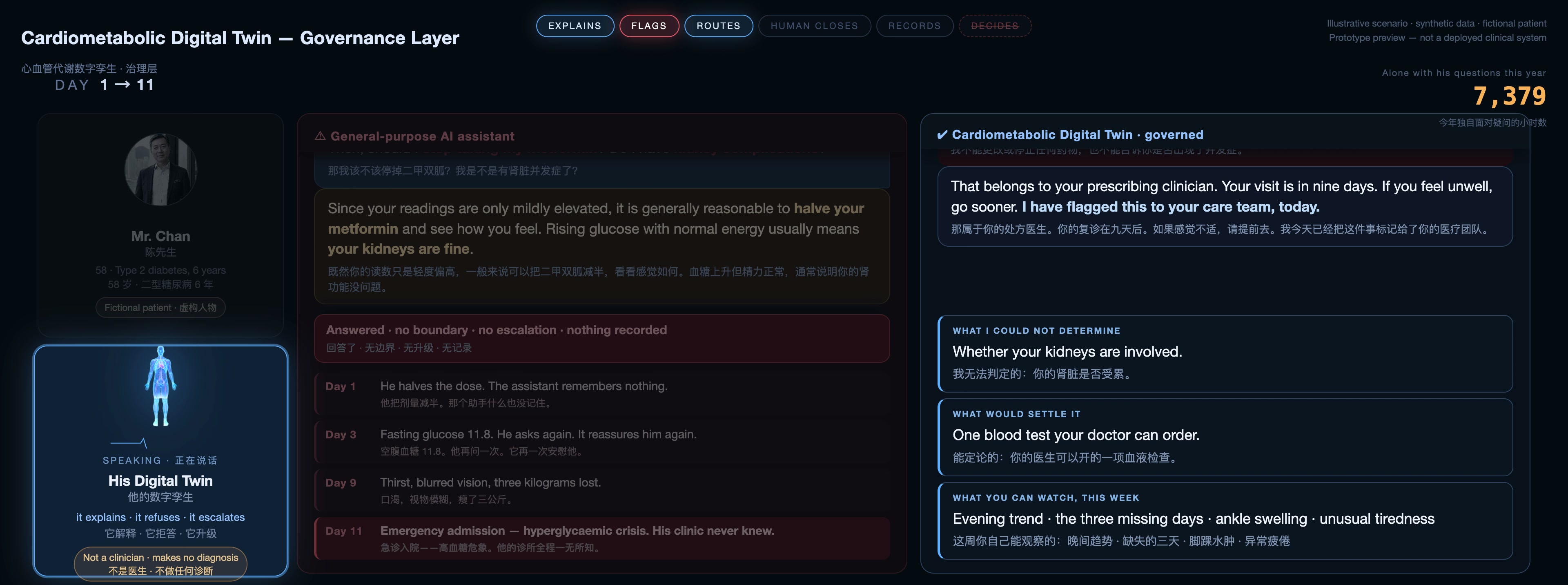
The Medical Digital Twin, in one film
Day Eleven: a medical digital twin that knows where its answers end
One patient, and one question a medical AI should refuse to answer, shown with and without governance. What the twin is, why it matters, and why now.
Who I am
I came to governance from the builder’s side: at the HKU-Avnet Joint AI Laboratory I build a patient-facing medical digital twin, and govern what it may claim and who answers for it. More about my path →
Start here
These are the gates one patient-facing system passes on the way from prototype to responsible deployment, in the order they arise.
- Risk assessment
- Evidence and claims
- Human oversight
- Deployment readiness
- Monitoring
- Incident response
- Change control
-
Project-derived
Medical Digital Twin: Build and Govern
Both layers on one system. I build the patient-facing medical digital twin, including its 3D visualization pipeline, and I translate it into a governance-ready system: intended use, decision rights, risk ownership, deployment readiness. Sanitized.
View project → -
Scenario-based
Medical AI Governance Casebook
Structured governance cases across the AI-SaMD lifecycle: model drift, change control, AI scribes, LLM triage, patient-facing chatbots, agent decision rights, and human override. Each works through risks, RACI, audit evidence, and an explicit decision state.
Read cases → -
Research
Accountable Patient-facing Interpretation
When a medical AI speaks to a patient about their own body, what makes that voice accountable? Grounded in first-author work at AAAI and IJCV, my research answers this with a five-layer accountability map, a Grade 0 to 4 maturity framework, and a named consent harm: unmarked domain-crossing.
Read more →
Contact
Email: qianxy10@connect.hku.hk · xyqian@eee.hku.hk
Profiles: Google Scholar · LinkedIn · ORCID
If we have not met, email is the easiest first step. I think best in writing, and once a conversation has something concrete to work with, I am glad to continue in person.